


Adhesive Capsulitis • Progressive Sports Medicine
Frozen Shoulder
Pain, stiffness and a loss of motion that creeps up slowly and then takes over. Frozen shoulder does resolve, but its natural course averages 12-18 months, and the right treatment at the right phase can spare you the worst of it.
Introduction
What is a frozen shoulder?
Frozen shoulder (adhesive capsulitis) is pain, stiffness and a loss of motion in your shoulder. Shoulder pains begin slowly, until there is a marked loss of motion in the shoulder: the capsule that wraps the ball-and-socket joint becomes inflamed, thickened and contracted, restricting movement in every direction.
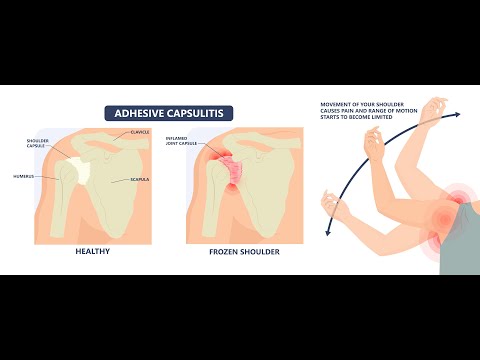 Watch: understanding frozen shoulder ▶ Watch on YouTube
The natural course
The three phases
Phase 1
Freezing (red)
The patient develops a slow onset of pain. As the pain worsens, the shoulder loses motion.
Phase 2
Frozen (blue)
The patient experiences a slow improvement in pain, but the stiffness remains.
Phase 3
Thawing (green)
The patient slowly regains full mobilisation of their shoulder as it returns to normal.
Watch how pain and motion move in opposite directions through the phases: pain peaks early while motion is still falling, then pain fades through the frozen phase before motion finally recovers in the thaw.
Risk factors
Who gets a frozen shoulder?
We aren’t entirely sure why frozen shoulder occurs; however, it is more likely to occur in patients who recently had to immobilise their shoulder for a long period, or after trauma (such as surgery or an arm fracture).
There is an association with auto-immune conditions such as Hashimoto’s and Graves thyroiditis, Type 1 diabetes, Coeliac disease and Pernicious anaemia: the so-called thyro-gastric cluster.
The link with diabetes is particularly strong. Patients with adhesive capsulitis have markedly higher rates of diabetes than the general population, especially in younger and middle-aged groups, which is why a new frozen shoulder is a prompt to check your metabolic health, including screening for diabetes and thyroid disease.

Diagnosis
How frozen shoulder is diagnosed
Frozen shoulder is a clinical diagnosis: the hallmark is a global restriction of shoulder movement that is present whether you move the arm yourself or someone moves it for you, with external rotation usually hit hardest. Part of the assessment is excluding the mimics, particularly rotator cuff problems, which restrict active more than passive motion.
Point-of-care ultrasound supports the diagnosis. One key finding in a frozen shoulder is increased blood flow and tissue thickening around the top of the biceps tendon: this region is called the rotator interval.


While not all of these approaches or tests are required to confirm the diagnosis, this diagnostic process lets us review any possible risks or existing conditions that could affect treatment and recovery.
Treatment
Treating a frozen shoulder, phase by phase
Frozen shoulder generally improves over time without any intervention; however, it can take an average of 12-18 months. Treatment exists to shorten the painful phases and protect your sleep, work and quality of life along the way.
The foundations are physiotherapy matched to the phase (gentle in the painful freezing phase, progressively firmer as it settles) and judiciously prescribed medication for pain and sleep. If symptoms are severe, affecting sleep quality and not controlled by physiotherapy and medication, escalation to corticosteroid injections is reasonable.
Steroid injections have been shown to be effective for pain in the early phases of a frozen shoulder. The location matters: injections are delivered under ultrasound guidance into the joint via the rotator interval at the front, or via a posterior approach, placing the medication precisely where the capsule is inflamed.


Hydro-dilatation(high-volume injection) has no strong evidence of being superior to cortisone injections, but may assist the return of range of motion in the later phases.
A word on surgery. Most surgeons do not like to operate in the early stages before the condition has stabilised, as surgery is known to cause frozen shoulder: it is thought that the trauma of surgery can stir up further immunological stimulus and make pain and stiffness worse. Therefore, patients tend not to be offered surgery while they are in the freezing phase.
The evidence
Key references
- Fields BKK, et al. Adhesive capsulitis: review of imaging findings, pathophysiology, clinical presentation, and treatment options. Skeletal Radiol 2019;48:1171–1184. doi:10.1007/s00256-018-3139-6
- Prestgaard T, et al. Ultrasound-guided intra-articular and rotator interval corticosteroid injections in adhesive capsulitis of the shoulder: a double-blind, sham-controlled randomized study. Pain 2015;156:1683–1691. doi:10.1097/j.pain.0000000000000209
- Catapano M, et al. Hydrodilatation with corticosteroid for the treatment of adhesive capsulitis: a systematic review. PM R 2018;10:623–635. doi:10.1016/j.pmrj.2017.10.013
Common questions
Frozen shoulder FAQs
Frozen shoulder generally improves over time even without any intervention, but it can take an average of 12-18 months to run through its freezing, frozen and thawing phases. That long natural history is exactly why we treat it actively: well-timed treatment shortens the painful early phase and protects your sleep, work and quality of life while the condition resolves.
We aren’t entirely sure why frozen shoulder occurs. It is more likely after a period of shoulder immobilisation or trauma, such as surgery or an arm fracture, and there is an association with autoimmune and metabolic conditions: Hashimoto’s and Graves thyroiditis, type 1 diabetes, coeliac disease and pernicious anaemia (the thyro-gastric cluster), and diabetes generally. This is why we screen for these conditions as part of the workup.
In frozen shoulder they genuinely help, particularly in the early, painful phases: high-quality trials of ultrasound-guided injections show meaningful reductions in pain. The injection treats the inflamed capsule and rotator interval directly, opening a window for physiotherapy, sleep and normal use, and it is precisely targeted under ultrasound guidance.
Hydrodilatation (a high-volume injection) gently stretches the contracted capsule from the inside with fluid. Honestly stated: it has no strong evidence of being superior to a standard corticosteroid injection, but it may assist the return of range of motion in the later phases. Whether it is worth doing depends on your phase and your goals, which is an individual decision made with you.
Rarely, and almost never early. Most surgeons do not like to operate before the condition has stabilised, because surgery itself is known to cause frozen shoulder: the trauma of an operation can stir up further immunological stimulus and make pain and stiffness worse. Surgery (such as capsular release) is reserved for the small group whose stiffness persists after the condition has settled and proper non-surgical care has been exhausted.
A shoulder that’s stiffening by the week and ruining your sleep?
Our Sport and Exercise Physicians in Leichhardt can confirm the diagnosis, screen the conditions that travel with it, and time each treatment to the phase you’re in, including precise ultrasound-guided injections in our rooms.
This page provides general information only and is not a substitute for personalised medical advice. Please consult a qualified health practitioner for assessment of your individual circumstances.