


Muscle & Soft Tissue • Progressive Sports Medicine
Muscle Injuries: Strains, Tears & Contusions
From a “corked” thigh to a torn hamstring, muscle injuries are among the most common problems in sport. Modern grading systems now let us predict recovery time and recurrence risk, and guide rehabilitation that actually prevents the next injury.
Introduction
Two main types of muscle injury
Muscle injuries include strains(indirect injuries, where muscle fibres tear under load) and contusions(direct injuries from an impact). The distinction matters, because the mechanisms, risks and treatment priorities differ.
Direct injury
Contusions (the “corked” muscle)
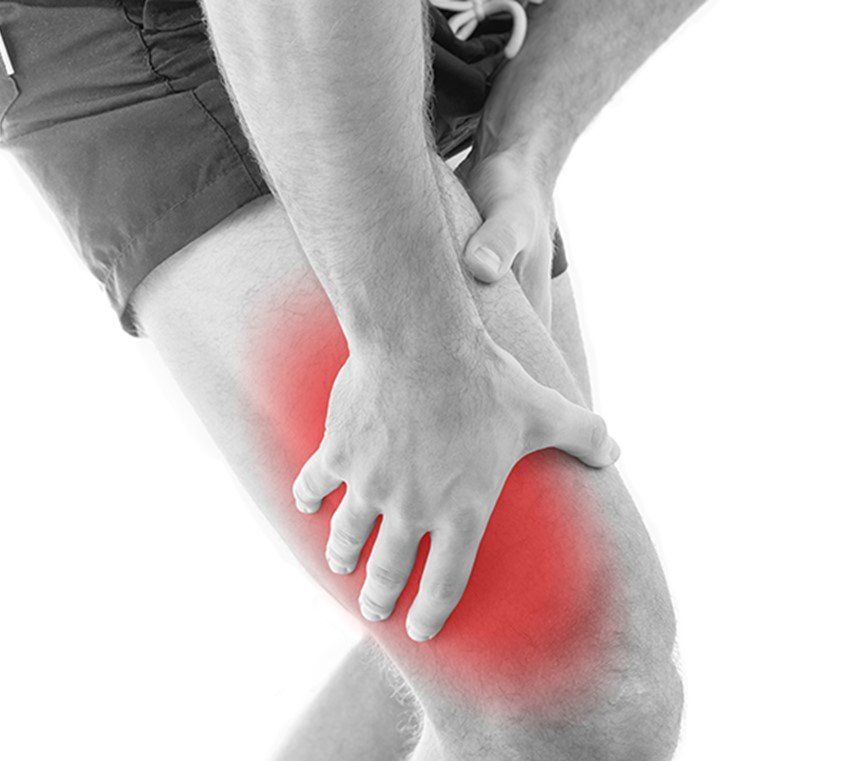
Contusions are caused by direct trauma to a muscle, which leads to bleeding and, in severe cases, destruction of muscle tissue. This is also known as a “cork” and often occurs in contact sports.
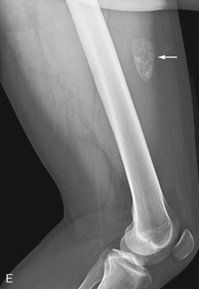
While most cases recover with simple treatments to limit inflammation, severe cases can lead to a condition known as myositis ossificans. This is where there is an area of muscle cell death and the haematoma (collection of blood) forms calcium instead of new muscle. The condition can lead to ongoing weakness and pain with muscle contraction that lasts many weeks and even months.
Indirect injury
Muscle strains and how we grade them
Muscle strains tend to occur with intense exercise when physical preparation is not ideal. However, they can occur despite the very best fitness, preparation and loading consistency.
When you “pull” a muscle, you tear muscle fibres. The old classification system for muscle injuries was a simple 1–3 grading of increasing severity. With the development of MRI, we now have more sophisticated ways of grading muscle injuries that help us predict how long recovery will take, and help us understand the risk of recurrent injury.
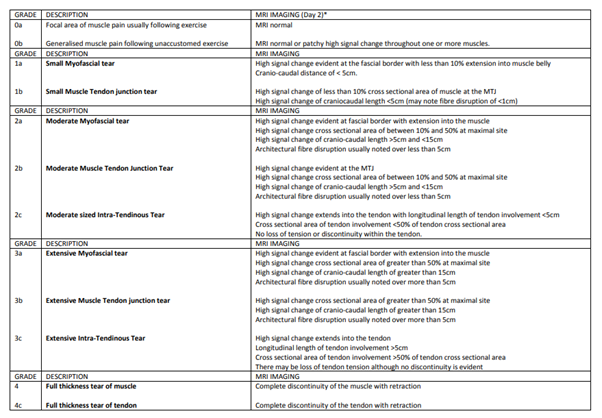
At our clinic we use the British Athletics Muscle Injury Classification (BAMIC), which grades both the extent of the injury (grades 0–4) and its location: (a) myofascial, (b) at the muscle–tendon junction, or (c) extending into the tendon itself. Tendon involvement matters most for recovery time and re-injury risk. View the BAMIC grading tables.
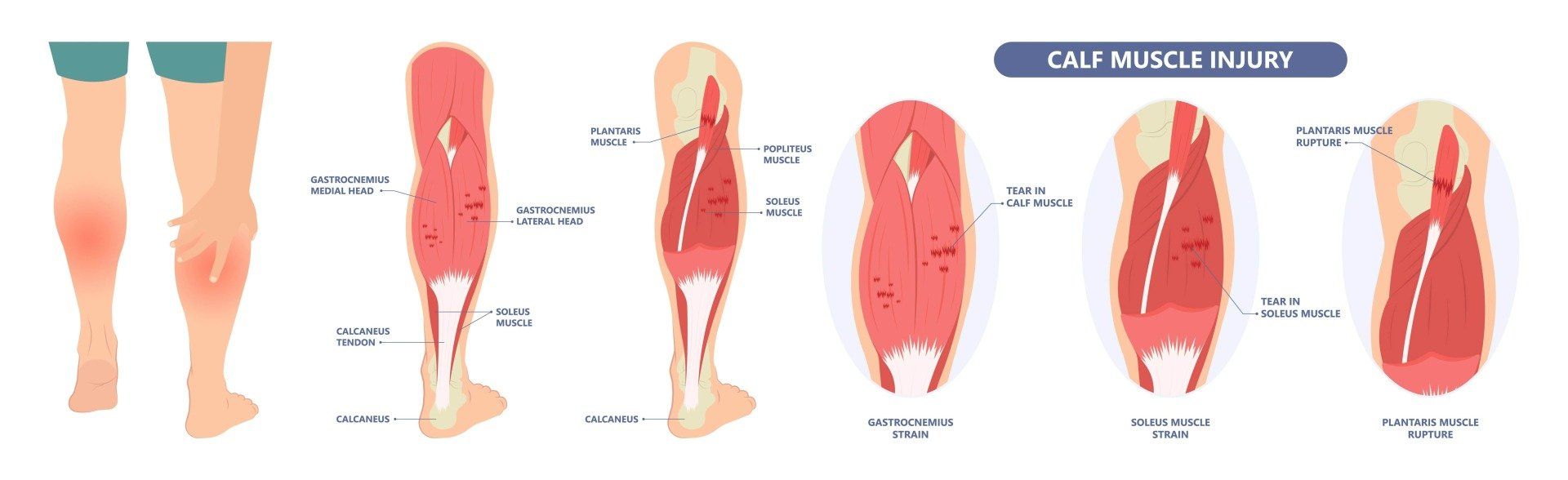
Most lower grade muscle strains can be diagnosed clinically without the need for MRI, and point-of-care ultrasound can assess the muscle in real time during your consultation. They recover from the moment of injury if the principles of POLICE are followed, and recovery should be guided by a physiotherapist or exercise physiologist to ensure rehabilitation milestones are met before return.
The difficult ones
Intramuscular tendon injuries
Intramuscular tendon injuries are among the more difficult muscle injuries to treat. They are often diagnosed after failed rehabilitation or recurrent injury, and they represent a loss of architectural strength to the tendon scaffold that runs in the middle of a muscle.
This is why an accurate early diagnosis matters: injuries that extend into the intramuscular tendon behave differently, take longer, and recur more often if rehabilitated like a simple strain.
Treatment
First response: POLICE, and do no HARM
Treatment begins from the moment of injury. We follow the POLICE principles:
- P
Protect: support and position the injury in a way that doesn’t worsen it.
- OL
Optimal Loading: rehabilitation begins as soon as the injury occurs. It is a matter of finding non-exacerbating load to stimulate and enhance tissue recovery.
- I
Ice: for comfort and pain relief. 10 minutes, as often as every 4 to 6 hours, for the first 2 days.
- C
Compression: to control swelling and bleeding within the muscle.
- E
Elevation: the most potent means of reducing swelling is lifting the limb above the level of the heart.
And do no HARM in the early days
H eat • A lcohol • R unning • M assage
Each of these can increase bleeding and swelling within a freshly injured muscle, and heavy stretching should also be avoided in the early stages.
Progressive rehabilitation needs to respect the physiology of healing: early mobility as tolerated, then progression through strength, length and velocity of muscle activity. Functional milestones are more helpful than arbitrary time-frames in decisions around return to play.
In high-risk cases (recurrent strains, high-risk athletes or muscle types) it is wise to aim for a degree of reserve and resilience beyond what is required to train and compete.
The evidence base
What the latest consensus statements say
Muscle injury care has been shaped by a series of international consensus statements. Our approach follows them, and we keep this page aligned as they evolve:
Munich consensus: naming the injury properly
The Munich consensus statement established today’s shared terminology, separating functional muscle disorders(no structural fibre tear, such as fatigue-related or neuromuscular tightness) from true structural injuries(partial tears through to complete tears and avulsions). Getting this distinction right prevents both over-treatment of functional problems and under-treatment of real tears.
Mueller-Wohlfahrt HW, et al. Terminology and classification of muscle injuries in sport: the Munich consensus statement. Br J Sports Med 2013;47:342–350. doi:10.1136/bjsports-2012-091448
BAMIC: grading that predicts recovery
The British Athletics Muscle Injury Classification grades injuries 0–4 by extent and (a/b/c) by site, with tendon involvement flagging longer recovery and higher re-injury risk. It is the system we use in clinic, and international surveys show it is now the most widely used classification among hamstring experts.
Pollock N, et al. British athletics muscle injury classification: a new grading system. Br J Sports Med 2014;48:1347–1351. doi:10.1136/bjsports-2013-093302
London International Consensus (2023): classification, surgery and rehabilitation
A three-part expert consensus on hamstring injuries, the most common muscle injury in running and pivoting sports. Part 1 confirmed BAMIC as the leading classification and recommended systems evolve to consider individual muscles and mechanism. Part 2 clarified the limited, specific indications for surgery. Part 3 recommended individualised rehabilitation built around exercise progression criteria, the kinetic chain, and graded running and sprinting before return to sport.
Paton BM, et al. Br J Sports Med 2023;57. Part 1: doi:10.1136/bjsports-2021-105371 • Part 2: doi:10.1136/bjsports-2021-105383 • Part 3: doi:10.1136/bjsports-2021-105384
Aspetar Hamstring Injury Rehabilitation Pathway (2026)
The most recent structured framework, developed at the Aspetar Orthopaedic and Sports Medicine Hospital and endorsed with strong agreement by elite-sport practitioners. It guides rehabilitation from injury through to return to performance, and is explicitly designed to support clinical reasoning rather than replace it, which matches how we individualise rehabilitation at PSM.
The Aspetar Hamstring Injury Rehabilitation Pathway. JOSPT Open 2026. doi:10.2519/josptopen.2026.0213
Common questions
Muscle injury FAQs
Most lower grade muscle strains can be diagnosed clinically without MRI, and point-of-care ultrasound can assess the muscle during your consultation. MRI becomes valuable for higher grade injuries and when intramuscular tendon involvement is suspected, because tendon involvement changes the expected recovery time and the rehabilitation plan.
Do no HARM: avoid Heat, Alcohol, Running and Massage in the early period after injury, as each can increase bleeding and swelling within the muscle. Instead follow POLICE: Protection, Optimal Loading, Ice, Compression and Elevation.
A cork is a contusion: direct trauma that causes bleeding within the muscle, common in contact sports. Most recover with simple measures to limit inflammation. Severe cases can develop myositis ossificans, where the collection of blood forms calcium instead of new muscle, causing weakness and pain that can last many weeks to months, which is one reason significant corks deserve proper assessment.
It depends on the grade and, importantly, the site of injury: modern grading systems such as BAMIC predict recovery time, and injuries involving the intramuscular tendon take longer and recur more often. Functional milestones are more helpful than arbitrary time-frames, and in high-risk cases it is wise to build a degree of reserve and resilience beyond what training and competing require.
The most common reasons are returning before rehabilitation milestones are truly met, unrecognised intramuscular tendon involvement, and rehabilitation that stops at pain-free rather than building strength, length and speed back into the muscle. The latest international consensus recommends individualised rehabilitation that progresses through strength, running and sprinting criteria before return to sport.
Pulled a muscle, or copped a bad cork?
Our Sport and Exercise Physicians in Leichhardt can grade your injury accurately, including point-of-care ultrasound assessment, and build a milestone-based rehabilitation plan aligned with the latest international consensus.
This page provides general information only and is not a substitute for personalised medical advice. Please consult a qualified health practitioner for assessment of your individual circumstances.