

Tendinopathy • Progressive Sports Medicine
Tendon Pain
Tendons are the body’s biological bungy cords: they store and release energy with every step, throw and lift. When their repair cannot keep up with their load, they become painful, and the treatment that rebuilds them is not rest, and not injections, but the right kind of loading.
Introduction
What is tendinopathy?
Sport and Exercise Physicians commonly see patients suffering from tendon pain. Common examples include:
“Tendinopathy” is a broad term that includes all types of tendon damage and injury. The tendon is the strong band of tissue that muscles use to attach to the bone.
 Watch: understanding tendon pain ▶ Watch on YouTube
The tissue
Biological bungy cords
Tendons are packed with dense collagen fibres in rows that allow them to store and release energy like biological bungy cords. Watch the calf and Achilles below: with every stride, the tendon stretches and recoils, returning energy that the muscles would otherwise have to produce.
Like most other tissues in our bodies they adapt to the stresses placed on them, and can withstand high-magnitude and repetitive forces in most sports and exercise activities. It is normal for tendon tissue to suffer microscopic injury with use; your body has ongoing repair mechanisms that maintain and increase tendon strength in response.
If the tendon is damaged quicker than it can repair, or if there are metabolic conditions that limit the quality of repair, the tissue gradually shifts from an organised, spring-like structure into a state of disrepair we call tendinopathy. The comparison below shows what changes inside the tendon.

Tendinopathy often results in stiffness, pain and weakness in particular movements. Often it feels worse when initiating new movement after periods of rest, like getting out of a chair or getting up in the morning.
The paradox
Why tendons hurt (and why scans can mislead)
Tendon pain is genuinely strange: it is localised, persistent and tightly linked to loading, yet the amount of damage on a scan often does not match the amount of pain. Some badly degenerated tendons never hurt at all, while some tendons with modest changes hurt a great deal.
Pain is not proportional to tissue damage, and relief of pain is not proportional to healing. As the tendon’s capacity to take load improves, the pain improves, regardless of the changes on high resolution ultrasound or MRI.
Part of the answer lies in what grows into a struggling tendon: new, abnormal blood vessels (“neovessels”) bring new nerve endings with them, and these are thought to be an important source of pain. Part of the answer also lies in the nervous system itself, which adapts to persistent tendon pain, which is why modern rehabilitation trains the brain-tendon connection as well as the tissue.
Point-of-care imaging
What we see on ultrasound
Point-of-care ultrasound is an extension of the examination. In tendinopathy it lets us assess the severity and stage of tendon change, and, critically, whether neovessels are present, because that finding changes which treatments are worth considering:


These findings guide treatment; they do not define you. Remember the paradox above: we treat your pain and capacity, and use the pictures to choose the right tools.
The mechanism
How tendons heal: mechanotransduction
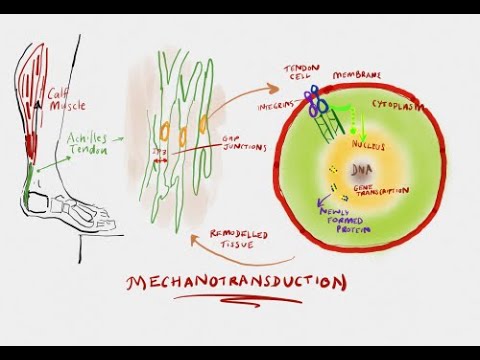
Why is exercise the treatment for a tissue problem? Because tendon cells are load sensors. When a tendon is loaded, its cells feel the stretch through anchoring proteins in their membranes and signal each other through connecting junctions. That mechanical signal travels to the nucleus, switches on gene transcription, and the cell manufactures new collagen protein, which is laid down as remodelled, stronger tissue.

This is the deepest reason there is no shortcut: the stimulus for tendon repair is the right dose of load. Too little, and there is no signal to adapt. Too much, and breakdown outpaces repair. The skill of tendon rehabilitation is holding the dose in the productive middle.
Treatment
The graduated challenge
Treatment is built on a graduated challenge to the tendon, progressing duration, then force, then speed. Early on, isometric holds (sustained tension without movement) can settle pain and begin the process. The load is then progressed so the tendon’s capacity gradually increases, regardless of what the imaging shows.

Around that central progression sit the supports that make it work: pain that is predictable and manageable during loading is acceptable and expected; the whole kinetic chain above and below the tendon is optimised; training becomes increasingly specific to your sport or job; and the raw materials matter, because collagen synthesis needs adequate protein (amino acid) availability. When progress stalls, we reassess for specific structural barriers.
Adjuncts can help the process along: shockwave therapy can desensitise a stubborn tendon enough to allow productive exercise, and a supervised program with our exercise physiology team keeps the progression honest. There are no recipes: every single tendon is different, and when managed correctly, and patiently, even the most difficult tendinopathy has an excellent chance of completely resolving.
Adjuncts
Injections for tendon pain
No injection rebuilds a tendon; only loading does that. Injections are adjuncts, used to settle pain and sensitivity enough to open a window for strengthening. We tend to avoid cortisone into tendons, as it has been shown to prolong recovery despite good short-term relief. PRP, targeted precisely at the zone of neovessel and nerve ingrowth, can markedly improve pain in the right patient. All injections are delivered under ultrasound guidance for accuracy.
This is what precision looks like in practice. Below is real footage from one of our procedures: a high-volume “stripping” injection at the Achilles, where fluid is guided along the tendon border to strip the neovessels and their accompanying nerves away from the painful tendon. You can see the tendon, the needle and the neovessels labelled on the live ultrasound.
Fellow travellers
Tendons and bursae: pain that travels together
Wherever tendons work hard, they glide, and wherever tissues glide, the body places a bursa: a thin, lubricating fluid sac that reduces friction. Because tendons and bursae live side by side, they frequently become painful together, and bursitis commonly coexists with tendinopathy at the shoulder, hip, knee, heel and elbow.

This is one reason an accurate diagnosis matters so much: treating a bursa while the neighbouring tendon (and the mechanics driving both) goes unaddressed rarely lasts. Our rotator cuff page walks through the best-known example of this partnership.
The evidence
Key references
- Rees JD, Stride M, Scott A. Tendons: time to revisit inflammation. Br J Sports Med 2014;48:1553–1557. doi:10.1136/bjsports-2012-091957
- Malliaras P, et al. Achilles and patellar tendinopathy loading programmes: a systematic review comparing clinical outcomes and identifying potential mechanisms for effectiveness. Sports Med 2013;43:267–286. doi:10.1007/s40279-013-0019-z
- Rio E, et al. The pain of tendinopathy: physiological or pathophysiological? Sports Med 2014;44:9–23. doi:10.1007/s40279-013-0096-z
- Rio E, et al. Tendon neuroplastic training: changing the way we think about tendon rehabilitation. Br J Sports Med 2016;50:209–215. doi:10.1136/bjsports-2015-095215
Common questions
Tendon pain FAQs
Tendinopathy is the broad, preferred term, because persistent tendon pain is usually driven more by a failed repair process than by simple inflammation. Anti-inflammatories can help settle a genuinely reactive, acutely flared tendon, but they are not the treatment that rebuilds the tendon. That job belongs to graduated loading.
No. One of the most important facts in tendon medicine is that pain is not proportional to tissue damage, and improvement in pain and function is not proportional to healing on the scan. As the tendon’s capacity to take load improves, the pain improves, regardless of what the pictures show. We treat your capacity, not your image.
Rest settles pain temporarily, but it does not rebuild the tendon’s capacity, and tendons detrain quickly. The evidence-based approach is optimal load: enough stimulus to trigger adaptation, with enough recovery to allow it, progressed carefully through duration, then force, then speed. Complete rest is usually part of the problem, not the solution.
There are no recipes, because every single tendon is different: its stage, its irritability, the loads your life and sport demand of it, and the rest of your kinetic chain all shape the program. As a framework, isometric holds can settle pain early, then loading is progressed through duration, force and finally speed, with the program built and supervised around you.
No injection rebuilds a tendon; only loading does that. Injections are adjuncts to settle pain and create a window for strengthening. We generally avoid cortisone into tendons, since it has been shown to prolong recovery despite short-term relief, while PRP targeted at the zone of new, abnormal vessel and nerve ingrowth can markedly improve pain in the right patient, always delivered under ultrasound guidance.
A tendon that flares every time you try to get going again?
Our Sport and Exercise Physicians in Leichhardt can stage your tendon with point-of-care ultrasound, find what’s driving it, and build the graduated loading plan, with the right adjuncts at the right time, that finally resolves it.
This page provides general information only and is not a substitute for personalised medical advice. Please consult a qualified health practitioner for assessment of your individual circumstances.