


Elbow & Forearm • Progressive Sports Medicine
Tennis Elbow (Lateral Elbow Tendinopathy)
Pain on the outside of the elbow that flares with gripping and lifting. Despite the name, tennis is rarely the cause these days, and despite its reputation, even the most stubborn tennis elbow has an excellent chance of completely resolving with the right approach.
Introduction
What is Tennis Elbow?
There are many different medical terms for Tennis Elbow, such as lateral epicondylitis or lateral elbow tendinopathy. Many muscles on the back of the forearm all join and attach near the elbow by a small, shared tendon. Tennis Elbow occurs when that tendon gets overloaded, inflamed, strained, or a combination of all three.
It commonly occurs due to unaccustomed, heavy or repetitive hand, wrist or forearm activities. It is now quite uncommon for tennis to be the cause, as racquets have become lighter and forehand techniques have changed a lot since the condition was first named.
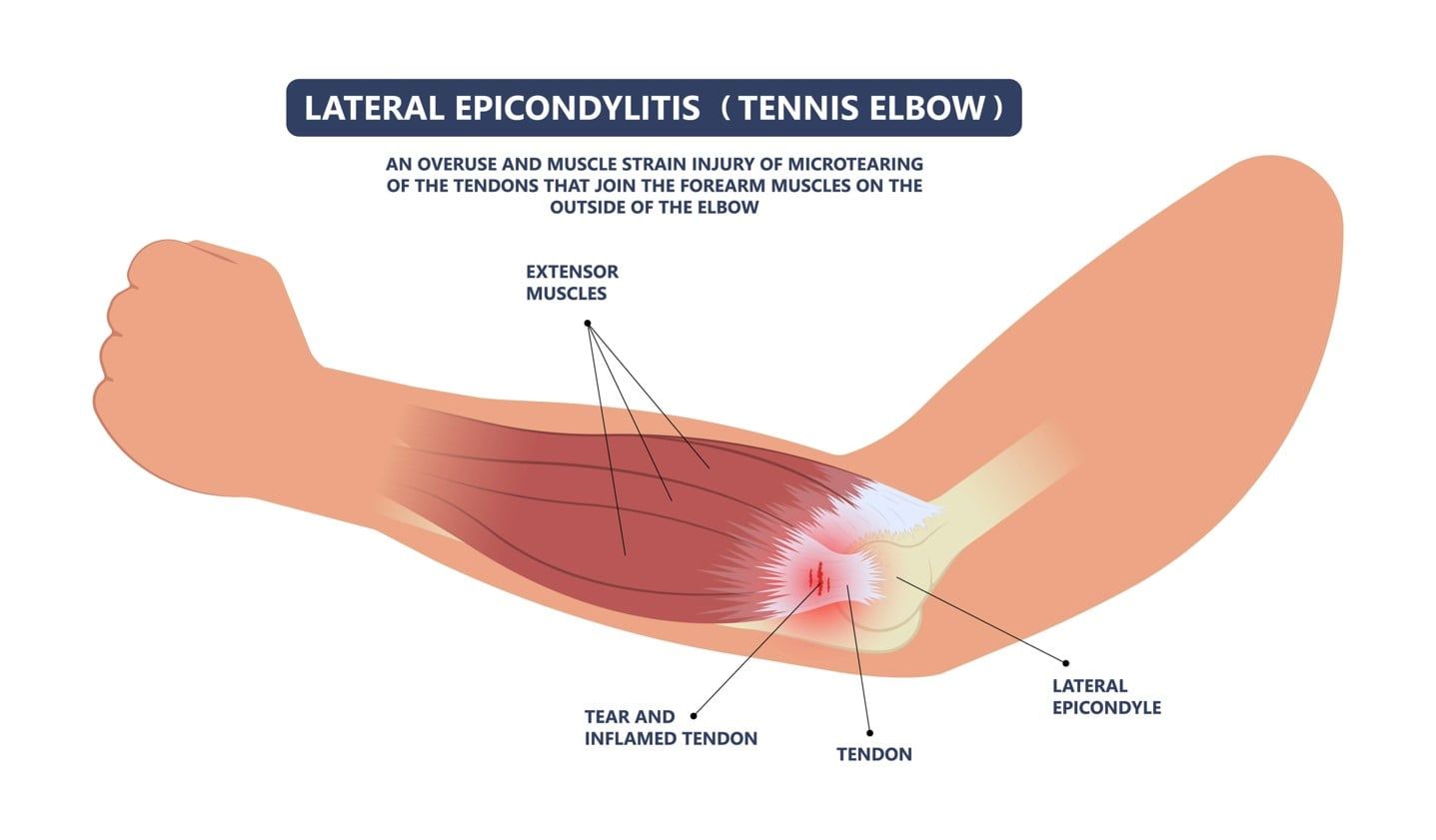
The average duration of pain with tennis elbow is 12–18 months. The main feature is pain directly on the outside bony point of the elbow, usually aggravated by lifting and gripping at certain angles of elbow, forearm and wrist movement.
Anatomy
The elbow is more complex than it gets credit for
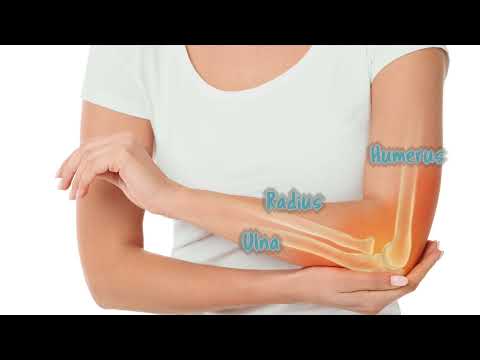
Anatomically, the elbow is a joint formed by 3 bones: the radius, ulna and humerus. It moves as a hinge joint, but importantly there is a smaller joint that communicates with the main elbow joint, called the radio-capitellar joint, which allows forearm rotation.
This rotation is crucial to human upper limb function. It allows us to rotate the hand into different positions so we can grip, grapple and manipulate objects, and it is exactly these functions that load the lateral elbow.
Diagnosis
How lateral elbow tendinopathy is diagnosed
In the vast majority of cases, Tennis Elbow can be diagnosed by a Sport and Exercise Physician without the use of scans, but there is often much more nuance to a detailed diagnosis of elbow pain. When a problem is very recalcitrant, often there is something that has been missed.
Multiple structures in this area can be responsible for pain, and often they overlap. While the extensor tendons are the most common cause, an accurate diagnosis matters when symptoms are prolonged, because the right tools need to be targeted at the right problem:
PIN nerve entrapment
The posterior interosseus nerve (PIN) can be entrapped as it runs into the supinator muscle. This tends to cause radiating pain and tenderness around the nerve down the back of the forearm, and more weakness than lateral elbow tendinosis alone.
Biceps tendon
People think of the biceps as the muscle at the front of the elbow, but its tendon spirals under the radius to attach on the undersurface, which can create pain toward the outer part of the elbow.
Radio-capitellar joint
The underlying joint can be a source of pain, usually with cartilage wear, especially in people who have had previous elbow fractures or trauma to this area.
 Lateral elbow pain & the PIN nerve explained ▶ Watch on YouTube
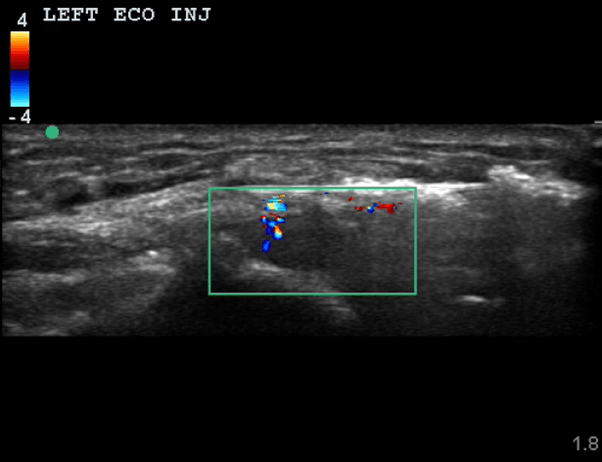
A comprehensive clinical examination, and often more advanced imaging, helps accurately define the source of pain, and hence the best treatment, for each individual. Point-of-care ultrasound is an extension of the examination: it can identify factors that guide treatment (the severity of tendon wear, the presence of “neovessels”, and the effects of movement on the tendon) and help exclude other isolated or coexisting causes such as radio-capitellar arthritis and PIN entrapment.
Treatment
What is the treatment for Tennis Elbow?
There is no single treatment for Tennis Elbow. Sometimes an acute onset is “reactive”, meaning inflammation is a factor, and medication or injections to reduce inflammation will help. Often tendon wear and tear is involved, and this repairs best not with rest but with specific exercises that encourage it to heal in the correct way. It is important these exercises are done correctly, because the wrong exercises can aggravate the problem.
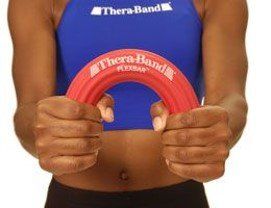
When lateral elbow tendinopathy is confirmed, we focus on activity modification and gradual tendon strengthening. The tendon needs to be challenged not only in its extensor function but also in its grappling and twisting (supination) function, which is why we usually recommend a flexbar with progressive resistance training.
Be careful with counter-force braces used for long periods. They can irritate the posterior interosseus nerve, which supplies the muscles of the forearm, and make the pain and weakness worse. Used briefly and early, a counter-force brace can be a helpful tool for pain.
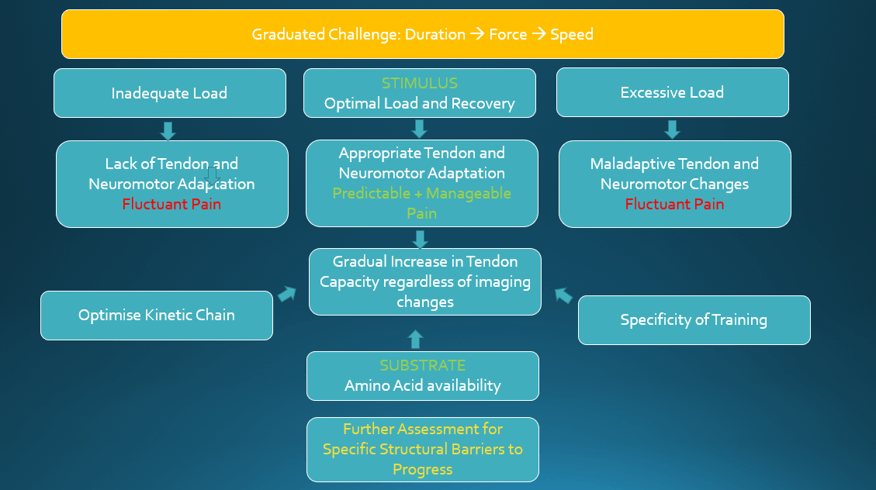
With all tendon pain, it is very important to understand that pain is not proportional to tissue damage, and relief of pain is not proportional to healing. As the tendon’s capacity to take load improves, the pain improves, regardless of the changes on high resolution ultrasound or MRI.
Therefore, the focus is to help de-sensitise pain to promote the ability to perform strength exercises. Isometric exercises, where a lower level of tension is held in the muscles for a prolonged time, can also help with pain. Changing lifting technique so that leverage on the elbow is minimised helps reduce aggravation during daily activities.
Usually we also need to address the underlying causes, whatever they are identified to be. Your Sport and Exercise Physician will carefully take you through this process, because every single tendon is different. There are no recipes. When managed correctly, and patiently, even the most difficult Tennis Elbow has an excellent chance of completely resolving.
Injections
Do injections for Tennis Elbow work?
Sometimes Tennis Elbow requires an injection, but this should never be the only treatment. Injections are an adjunct, considered when other treatments have been tried.
We tend to avoid cortisone injections for the tendon itself, as cortisone has been shown to prolong recovery despite giving good short-term relief. Cortisone may be warranted if the problem is not caused by the lateral elbow tendons, for example the nearby joint or nerve.
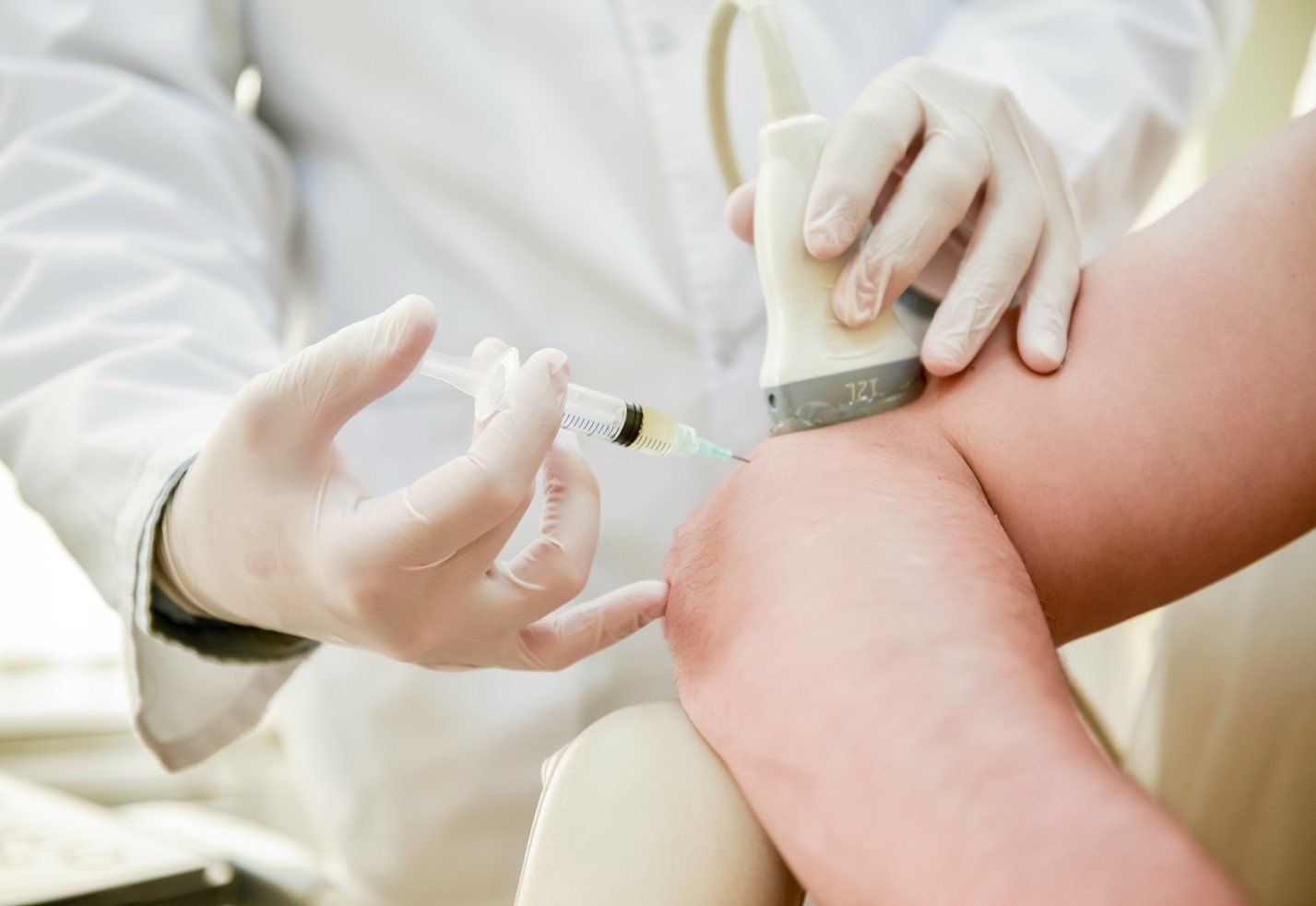
A consistent strengthening program targeting the extensor-supinator compartment is the most important treatment, but sometimes adjuncts are needed to reduce pain and sensitivity. PRP injections, targeted at the point of new, abnormal nerve and blood vessel ingrowth, can markedly improve pain, in preference to corticosteroid injections. All injections are delivered under ultrasound guidance for accuracy.
Surgery
Is surgery required for Tennis Elbow?
It is extremely rare for correctly administered non-surgical treatments to fail and for surgery to be required in this condition. Manual labourers and professional athletes are more likely to have time pressure for recovery, and may undergo tendon debridement surgery.
Common questions
Tennis Elbow FAQs
Rarely, these days. Racquets have become lighter and techniques have changed since the condition was named. Most cases are caused by unaccustomed, heavy or repetitive hand, wrist or forearm activity, at work, in the gym, or around the house.
The average duration of pain is 12 to 18 months when it is left to run its course. With an accurate diagnosis and a correctly graded strengthening program, even the most difficult tennis elbow has an excellent chance of completely resolving, and usually much sooner than that.
Generally no. Cortisone gives good short-term relief but has been shown to prolong recovery for lateral elbow tendinopathy, so we tend to avoid it for the tendon itself. It may be warranted when the problem is not the tendon, for example the nearby joint or nerve, which is why the diagnosis matters so much.
A counter-force brace can be a helpful tool early on to reduce pain and allow strength work to begin. But be careful using these braces for long periods: they can irritate the posterior interosseus nerve, which supplies the forearm muscles, and make pain and weakness worse.
It is extremely rare for correctly administered non-surgical treatment to fail and for surgery to be required. Manual labourers and professional athletes under time pressure for recovery are the group most likely to consider tendon debridement surgery.
Elbow pain that grips every time you grip?
Our Sport and Exercise Physicians in Leichhardt can pinpoint the true source of your lateral elbow pain, including point-of-care ultrasound assessment, and build a graded strengthening plan that actually resolves it.
This page provides general information only and is not a substitute for personalised medical advice. Please consult a qualified health practitioner for assessment of your individual circumstances.