


Hip & Pelvis • Progressive Sports Medicine
Hip & Groin Pain
Groin pain is often complex and multi-factorial. Several inter-related structures share this region, they often overlap in the same patient, and a precise diagnosis is what turns a frustrating problem into a treatable one.
Introduction
Why this region is tricky
There are a number of inter-related structures around the groin, so there is often overlap in the anatomical structures that generate pain, and sometimes these pain generators coexist in the same patient.
While every individual is different, it is now thought that excessive torsional and shear forces, particularly under fatigue, lead to micro-movement in the pelvis that overloads these structures. The image below shows how compression, shear and torsion load the pelvis, and why cutting and kicking sports concentrate these forces.

The hip joint
Hip impingement (FAI) and labral tears
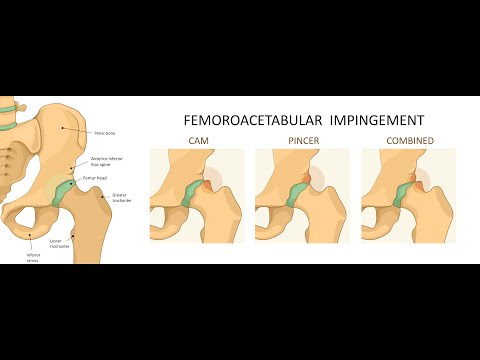
One cause of hip and groin pain is hip impingement with labral tears. The labrum of the hip, known as the acetabular labrum, is a biological washer that improves the congruence and stability of the joint. There are several reasons why the labrum may develop a tear, but one of the most common is the shape of the hip joint itself lending toward abrasion of the labrum.
 Watch: labral tears explained ▶ Watch on YouTube
Some patients are born with a shallower hip socket, a condition known as developmental dysplasia of the hip, which puts increased load on the edge of the socket. Others develop bony bumps around their growth plates during adolescence, leading to pinching (impingement) of the soft tissues at the front of the socket, including the labrum, as the knee moves up toward the chest. This is called FAI or hip impingement syndrome. Both patterns are shown in the images below.


One of the challenges faced by clinicians is that tears of the labrum are not always painful. The person and their examination findings matter more than the scan alone.
Patients with symptomatic FAI syndrome often give a history of pain with increased squat and lunge depth, prolonged sitting, and hip flexion activities that bring the knee toward the chest.
Patients with more severe FAI and labral tears are known to be at a higher risk of developing hip osteoarthritis in future. However, there is no longitudinal evidence to suggest that surgery prevents hip osteoarthritis.
Our approach follows the international consensus on FAI syndrome: the diagnosis requires the triad of symptoms, clinical signs and imaging findings together, and appropriate treatments include conservative care, rehabilitation, or surgery in selected cases.
Griffin DR, et al. The Warwick Agreement on femoroacetabular impingement syndrome (FAI syndrome): an international consensus statement. Br J Sports Med 2016;50:1169–1176. doi:10.1136/bjsports-2016-096743

You can read more about the labrum itself, including why so many tears on scans are silent, on our meniscus & labral tears page.
Beyond the joint
The generators of groin pain
A comprehensive history and clinical examination can assist in directing the diagnosis toward the following generators of groin pain:
Inguinal-related
Including inguinal hernia and the so-called sportsman’s hernia, where the structures of the inguinal canal and posterior wall generate pain with straining and exertion.
Adductor-related
The inner thigh muscles and their tendon attachment at the pubic bone, typically painful with squeezing the legs together, kicking, sprinting and change of direction.
Iliopsoas-related
The deep hip flexor at the front of the hip, typically painful with resisted hip flexion and stretching into extension.
Pubic-related
The pubic symphysis and adjacent bone, loaded by the torsional and shear forces of running and kicking sports, particularly under fatigue.
Hip-related
The hip joint itself, including FAI, labral tears and early osteoarthritis, typically felt deep in the groin with rotation, squatting and prolonged sitting.
Other sources
Referred pain and less common causes, from the lumbar spine, nerves and other structures, are considered when the pattern doesn’t fit.
The anatomy image below shows how closely the iliopsoas, adductors and abdominal attachments converge on the pubic bone, and why kicking and cutting sports load them all at once.


Diagnosis
How we work it up
Diagnosis starts with a comprehensive history and clinical examination of every candidate structure, from the hip joint through the adductors, hip flexors, pubic region and inguinal canal, and considering referred sources.
Further advanced imaging may include pelvic X-rays (with Flamingo views to assess stability of the pubic symphysis), ultrasound and MRI. Sometimes these pain generators coexist in the same patient, which is exactly why the workup is systematic rather than scan-first.
Treatment
Treatment: individualised, and generator by generator
Because groin pain is multi-factorial, treatment is individualised to the structures involved. The foundations are load management(modifying the aggravating positions and volumes, not stopping everything) and progressive strengthening of the adductors, hip flexors, gluteals and trunk, restoring the pelvis’s ability to absorb torsional and shear forces without micro-movement.

For hip-related pain, deep squat and lunge depth and prolonged hip flexion are moderated while strength is built. Guided rehabilitation with a physiotherapist or exercise physiologist keeps the progression honest.
When pain blocks progress, targeted injections delivered under ultrasound guidance can serve two purposes: confirming the pain source diagnostically, and settling it enough to rehabilitate. The image below shows a hip joint injection delivered under live ultrasound. A surgical opinion is sought for the specific problems that need one, such as true inguinal hernias or hip joint problems that remain symptomatic despite a proper course of conservative care.

Common questions
Hip & groin pain FAQs
Because several inter-related structures share the region, they often overlap in the pain they produce, and more than one pain generator can be active in the same patient at the same time. A comprehensive history and clinical examination is what directs the diagnosis, with imaging used to confirm and refine it.
FAI is where the shape of the hip, bony bumps that develop around the growth plates during adolescence, or a socket orientation that pinches, leads to impingement of the soft tissues at the front of the hip, including the labrum, as the knee moves toward the chest. By international consensus, FAI syndrome is diagnosed on the triad of symptoms, clinical signs and imaging findings together, not on imaging alone.
Not necessarily. Labral tears are not always painful, and silent tears are common. Diagnosis rests on matching your history and examination findings to the scan, and sometimes a diagnostic injection helps confirm whether the joint is truly the source.
No. Although people with more severe FAI and labral tears are at higher risk of developing hip osteoarthritis in the future, there is no longitudinal evidence that surgery prevents it. Surgical decisions should be based on current symptoms and function, not on preventing arthritis.
An individualised program: load management and activity modification for the aggravating positions, progressive strengthening around the hip and pelvis, and treatment of each identified pain generator. Injections delivered under ultrasound guidance can be used as a diagnostic tool and an adjunct when pain is blocking rehabilitation, and surgical opinions are sought for the specific problems that genuinely need them.
Groin pain that hasn’t been properly explained?
Our Sport and Exercise Physicians in Leichhardt can examine every candidate structure, use targeted imaging including point-of-care ultrasound, and build a plan for your specific combination of pain generators.
This page provides general information only and is not a substitute for personalised medical advice. Please consult a qualified health practitioner for assessment of your individual circumstances.
The evidence
Key references
- Griffin DR, et al. The Warwick Agreement on femoroacetabular impingement syndrome (FAI syndrome): an international consensus statement. Br J Sports Med 2016;50:1169–1176. doi:10.1136/bjsports-2016-096743
- Weir A, et al. Doha agreement meeting on terminology and definitions in groin pain in athletes. Br J Sports Med 2015;49:768–774. doi:10.1136/bjsports-2015-094869
- Frank JM, et al. Prevalence of femoroacetabular impingement imaging findings in asymptomatic volunteers: a systematic review. Arthroscopy 2015;31:1199–1204. doi:10.1016/j.arthro.2014.11.042