

Most of the cardiovascular risk we screen for is a snapshot in time. A blood pressure reading, a cholesterol result, a single glucose measurement: each captures one moment. Cardiorespiratory fitness is different. It reflects how well the heart, lungs, blood vessels, and muscles work together as one system, and it turns out to be one of the strongest measurable predictors of long-term health we can put a number on in the clinic. That number is VO2 Max, and understanding the link between VO2 Max and mortality risk is one of the most useful things you can do for your future health.

What VO2 Max actually measures
VO2 Max is the maximum amount of oxygen your body can take in and use during intense exercise, measured in millilitres of oxygen per kilogram of body weight per minute. It is the reference standard for cardiorespiratory fitness. The higher your VO2 Max, the more oxygen your body can deliver and use under load, which reflects the combined health of your heart, lungs, circulation, and working muscles. Because it integrates so many systems at once, it is far more informative than any single resting measurement.
Why fitness predicts more than most single markers
The evidence here is substantial. In a cohort of more than 122,000 adults referred for exercise treadmill testing, Mandsager and colleagues found that lower cardiorespiratory fitness was associated with higher all cause mortality, and that the association was at least as strong as established risk factors such as coronary artery disease, type 2 diabetes, and smoking. Importantly, they observed no ceiling of benefit. The fittest patients continued to show lower risk, with no upper limit at which additional fitness stopped helping.
This is why leading bodies now argue that fitness deserves a place alongside the vital signs we already measure. An American Heart Association scientific statement led by Ross and colleagues made the case for treating cardiorespiratory fitness as a clinical vital sign, on the grounds that low fitness is a powerful and independent predictor of cardiovascular disease and death, yet is rarely measured in routine care.

Why this matters in practice: fitness is modifiable
The most valuable feature of VO2 Max is that, unlike your age or your family history, it is something you can change. A measured VO2 Max gives you two things at once: an estimate of your current risk, and a concrete target to train towards. Structured aerobic training, built gradually and matched to your starting point, can meaningfully improve cardiorespiratory fitness over time. That means the risk a low result signals is not fixed. It is a starting line.
The risk a low result signals is not fixed. It is a starting line.
How VO2 Max is measured at Progressive Sports Medicine
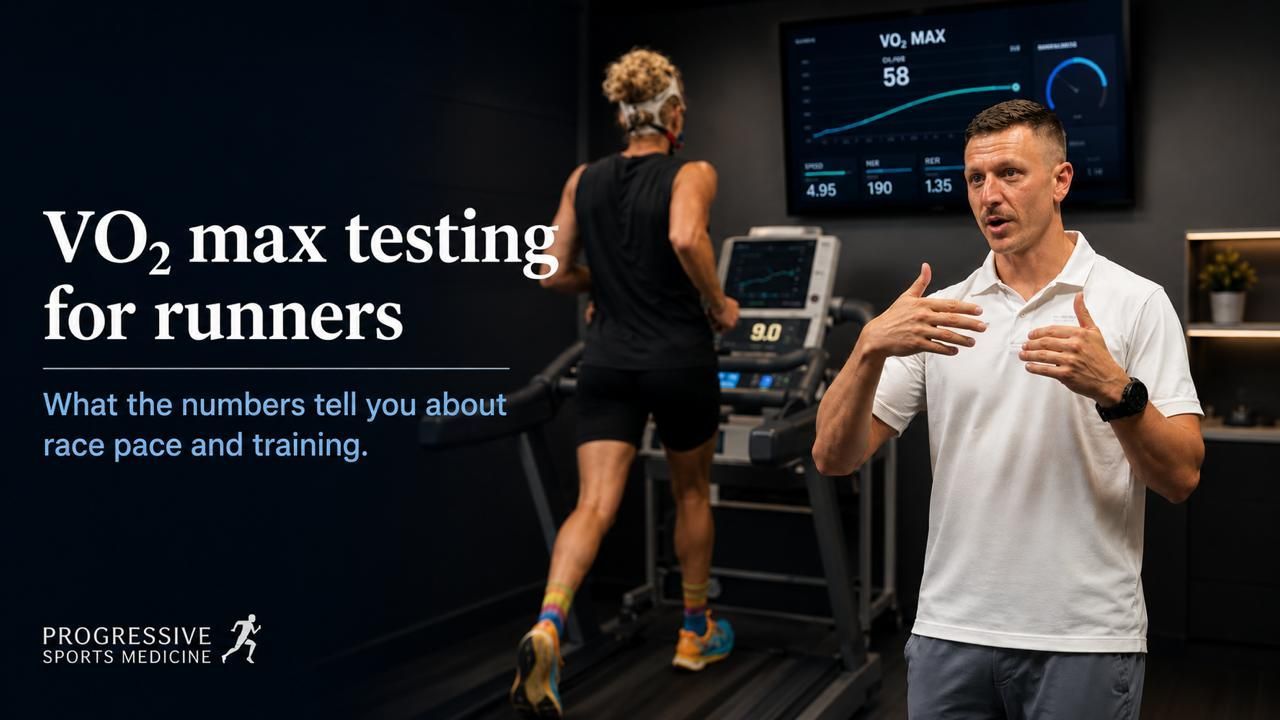
At Progressive Sports Medicine, VO2 Max is measured directly using a cardiopulmonary exercise test as part of the Phase 1 assessment of the Exercise Medicine Healthspan Program. Rather than estimating fitness from a formula, the test measures the oxygen you actually use while you exercise to your individual limit, on a bike or treadmill, wearing a mask that analyses each breath. The result is interpreted against your age and sex, so you see where your fitness sits and by how much there is room to improve.
Measurement is only the first step. The philosophy is diagnostic first, intervention second: measure, then act on the data. Your result is translated into an individualised exercise prescription, supervised by an accredited exercise physiologist, so the training you do is matched to the number rather than guessed at. Measure first, then prescribe.

What a good result looks like
There is no single “good” VO2 Max that applies to everyone, because fitness is interpreted relative to age and sex. A result is best read as a percentile against your age band, which shows how your fitness compares and where realistic gains can be made. The goal is not a perfect score. It is a clear, honest baseline and a plan to move it in the right direction.
The next step
If you are carrying cardiovascular or metabolic risk and want an objective measure of your fitness to anchor the conversation, a measured VO2 Max is an informative place to start. Speak to your GP about a referral, or get in touch with the clinic to discuss an assessment.