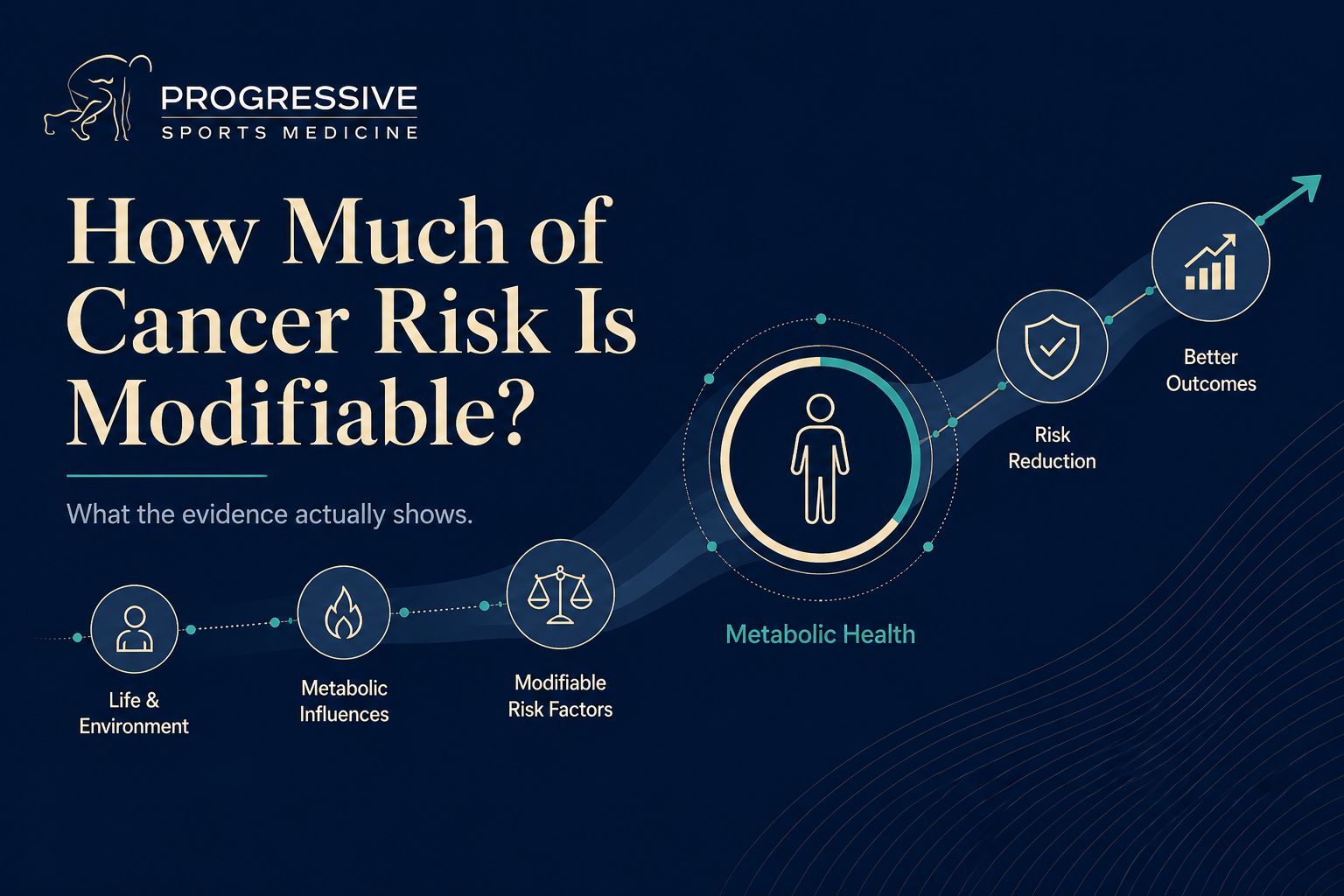


What Makes a Nutrition Strategy Work for You

July 31, 2026
Why the Same Meal Affects Two People Differently | Progressive Sports Medicine
PROGRESSIVE SPORTS MEDICINE Why the same meal affects two people differently Ask about an assessment
Progressive Sports Medicine panel headed What Makes a Nutrition Strategy Work for You, beside an overhead photograph of a plate of salmon, leafy greens, avocado, blueberries, egg, chickpeas, nuts and grains, with small line icons for the liver and metabolic markers linked to it
Nutrition and Metabolic Health

Why the same meal affects two people differently

Nutrition advice is generic. Physiology is not. What the evidence says about protein, fructose, and why two people can eat the same meal and get different results.


~5 min read
01

The advice is generic. Your physiology is not.

Most people have followed nutrition advice that worked for someone else and did very little for them. That experience gets read as a failure of discipline. More often it is a failure of specificity. Population level dietary advice is built to be safe across millions of people, which is exactly what makes it approximate for any one of them.

The useful question is not which diet is correct. It is which mechanisms are doing the work, and how much they vary between people. Dr Samra works through exactly that in the nutrition lecture of our education series, and this article covers the same ground in short form. You can watch the full lecture here: https://www.youtube.com/watch?v=vpslg5MchjU

02

Three levers, not thirty rules

Nutrition becomes tractable when it stops being a list of foods and starts being a small number of physiological levers. Protein intake, which determines whether muscle is preserved or lost. Fructose and added sugar load, which the liver handles differently to other carbohydrate. And the individual glucose response to a given meal, which turns out to vary far more between people than the food labels suggest.

Almost everything argued about publicly sits downstream of those three.

03

Protein and holding on to muscle

Muscle mass is not a cosmetic concern. It is the tissue that keeps people functional and metabolically healthy across decades, and it is lost quietly from midlife unless it is deliberately defended. Protein and resistance training are the two levers that defend it.

Protein and holding on to muscle. Three linked panels: protein adequacy, which supports muscle protein synthesis and repair; resistance training, which provides the stimulus to maintain muscle; and muscle preservation, which helps maintain strength, function and independence.

Morton and colleagues pooled 49 trials covering more than 1,800 participants and found that protein supplementation produced a consistent additional gain in fat free mass and strength when combined with resistance training. Their meta regression also found the benefit levelling off at around 1.6 grams of protein per kilogram of body weight per day, with no clear further gain above that ( Morton and colleagues, 2018).

Two things follow. Protein without a training stimulus is not the same intervention. And more protein is not indefinitely better, which is a useful correction to how the topic is usually marketed.

04

Fructose and the liver

Fructose is metabolised chiefly by the liver rather than being taken up broadly by the body's tissues, which is why it behaves differently from glucose at higher intakes.

Stanhope and colleagues tested this directly. Overweight and obese adults consumed beverages sweetened with either fructose or glucose, providing a quarter of their energy requirement, for 10 weeks. Both groups gained similar weight. Only the fructose group showed a significant increase in visceral fat, in fasting glucose and insulin, and in markers of new fat production in the liver, alongside reduced insulin sensitivity ( Stanhope and colleagues, 2009).

That is a high intake in a controlled setting and it should not be read as a claim about ordinary fruit, which comes with fibre, water, and volume that limit how much fructose arrives at once. What it does show is that the source of the sugar changes where it ends up, and that liver fat can accumulate without the scales moving.

Fructose and the liver, in three steps. A higher fructose load is handled differently from many other carbohydrates. At higher intakes, the liver becomes the main site of processing. The downstream effects observed were more liver fat production, a rise in visceral fat, and reduced insulin sensitivity. Noted alongside: whole fruit is not the same as a high added sugar intake, because fibre, water and volume change how much fructose arrives at once.
05

Your own glucose response is the variable nobody measured

The strongest recent evidence for personalising nutrition is that identical meals do not produce identical responses.

Your own glucose response is the variable nobody measured. Two sets of glucose curves plotted against time. In the first, the same standardised meal produces clearly different responses in different people. In the second, the same standardised meal produces different responses in one person across different contexts. Listed alongside as contributing factors: muscle mass, sleep debt, stress hormones, microbiome, and recent activity.

Zeevi and colleagues continuously monitored glucose in 800 people across roughly 47,000 meals and found that responses to the same standardised food varied widely between individuals, in ways a food's published glycaemic index did not predict ( Zeevi and colleagues, 2015). Berry and colleagues replicated the pattern in 1,002 adults, and found that genetics accounted for only a modest share of the variation, while meal composition, timing, and individual metabolic factors accounted for a great deal more ( Berry and colleagues, 2020).

Two consequences matter clinically. Advice built purely from a food's average behaviour will be wrong for a meaningful proportion of people. And because most of the variation is not genetic, it is measurable and often modifiable, which is precisely why continuous glucose monitoring sits inside the assessment rather than alongside it.

06

Where a dietitian changes the outcome

Data on its own does not change what anyone eats on a Wednesday night. Translating a glucose trace, a body composition result, and a protein target into a way of eating that a person will still be following in a year is a distinct skill, and it is the reason dietitian consultation sits in the same assessment as the testing rather than being offered afterwards as an optional extra. Measure first, then build the plan around what the measurement actually showed.

Measure first, then build the plan. A five step cycle: measure, collecting objective data that matters; interpret, turning data into clear insight; personalise, building a plan around your physiology, goals and lifestyle; implement, putting the plan into action with support that fits your life; and reassess, tracking progress and adapting the plan.
07

Next step

If you have followed sound nutrition advice and not seen it reflected in your results, the gap is worth measuring rather than guessing at. Speak to your GP about a referral, or get in touch with Progressive Sports Medicine to ask about a comprehensive assessment.

If you would rather start with the science, Dr Samra's full nutrition lecture covers each of these mechanisms in depth: https://www.youtube.com/watch?v=vpslg5MchjU

The useful question is not which diet is correct. It is which mechanisms are doing the work, and how much they vary between people.
08

References

  • Morton RW, Murphy KT, McKellar SR, and colleagues A systematic review, meta analysis and meta regression of the effect of protein supplementation on resistance training induced gains in muscle mass and strength in healthy adults. British Journal of Sports Medicine. 2018;52(6):376 to 384. https://doi.org/10.1136/bjsports-2017-097608
  • Stanhope KL, Schwarz JM, Keim NL, and colleagues Consuming fructose sweetened, not glucose sweetened, beverages increases visceral adiposity and lipids and decreases insulin sensitivity in overweight and obese humans. Journal of Clinical Investigation. 2009;119(5):1322 to 1334. https://doi.org/10.1172/JCI37385
  • Zeevi D, Korem T, Zmora N, and colleagues Personalized nutrition by prediction of glycemic responses. Cell. 2015;163(5):1079 to 1094. https://doi.org/10.1016/j.cell.2015.11.001
  • Berry SE, Valdes AM, Drew DA, and colleagues Human postprandial responses to food and potential for precision nutrition. Nature Medicine. 2020;26(6):964 to 973. https://doi.org/10.1038/s41591-020-0934-0
Specialist led, team delivered. Dr David Samra, sport and exercise medicine specialist, Cameron Hyde, accredited exercise physiologist, and Robynne Jeftha, accredited practising dietitian, who work together to translate measurements into a practical plan.
Specialist Led · Leichhardt, Sydney

If sound advice has not shown up in your results, the gap is worth measuring.

Rather than guessing at why generic nutrition advice did not work, speak with your GP about a referral, or get in touch with Progressive Sports Medicine to ask about a comprehensive assessment.

Exercise Medicine Healthspan Program

Explore the assessment programme and what to expect.

Call the clinic

(02) 8540 8019
Tue to Fri, 8:30am to 6:00pm

Email us

office@progressivespecialists.com.au
General enquiries and referrals

PROFESSIONAL AND PATIENT NOTICE

The information presented here is intended for general education and professional discussion only. It is not a substitute for individual medical advice, diagnosis, or treatment. No intake target described here is a recommendation for any individual. Speak with your GP, a specialist, or an accredited dietitian before making changes to your diet, exercise, or health care.

~5 min left
READING PROGRESS
By Cameron Hyde July 9, 2026
By David Samra May 29, 2026
By David Samra May 17, 2026
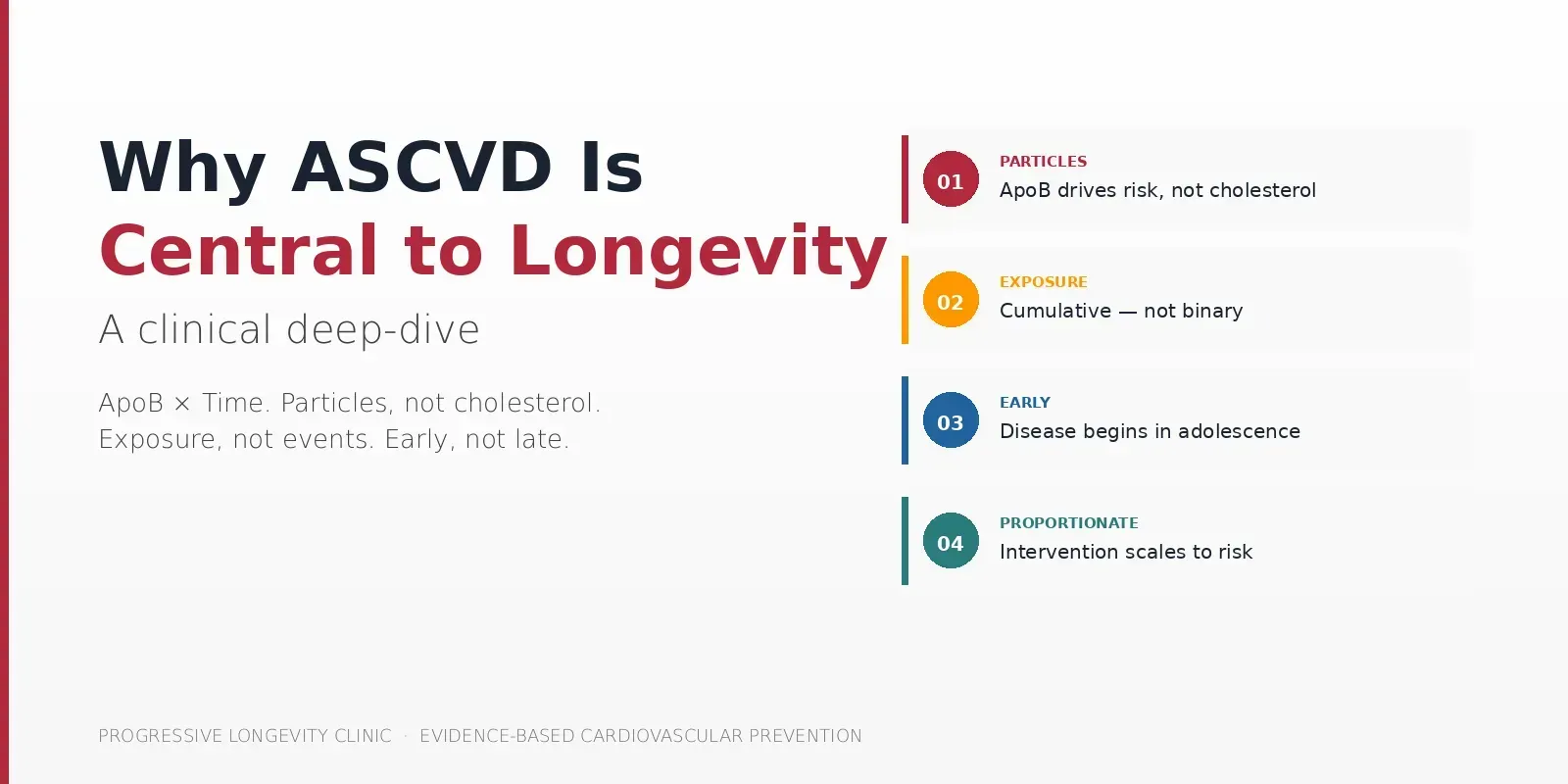
Clinical Summary from Dr David Samra Dr David Samra is a Fellowship-trained Sport and Exercise Medicine Physician with clinical experience focused on prevention of cardiovascular disease in both athletes and the general population. Atherosclerotic cardiovascular disease (ASCVD) remains the dominant limiter of lifespan and healthspan in Western populations. Across epidemiology, guidelines, and mechanistic biology, the data converges on the same point: cardiovascular events are late expressions of a disease process that begins decades earlier and accumulates silently. The clinical implication is significant. If we keep using risk tools designed to predict 10-year events, we will continue to miss disease that has been building for 30 years. This article works through the biology, the evidence, and the clinical framework that has shaped my approach at Progressive Longevity Clinic. Last reviewed: May 2026 Author: Dr David Samra, MBBS (Hons), MD, FACSEP – Sport and Exercise Medicine Physician
By Cameron Hyde July 24, 2025
Why Strength Training is Essential for Building Stronger Bones If you think lifting weights is only for building muscle, think again. Strength training is one of the most effective tools we have to improve bone health, reduce fracture risk, and enhance overall function — especially as we age. At Progressive Sports Medicine, we integrate research-backed strategies like resistance training to help clients maintain bone density and prevent the cascade of issues associated with osteoporosis. The Problem: Bone Loss and Fracture Risk After age 30, we naturally begin to lose bone mass. For many, this can lead to osteopenia, osteoporosis, and an increased risk of fractures — especially in the spine, hip, and wrist. Fractures aren’t just painful. They lead to reduced mobility, independence, and even increased mortality in older adults. The Solution: Strength Training for Skeletal Health Emerging research and clinical consensus show that progressive resistance training (PRT) can directly improve bone health. But it’s more than just building density — it improves muscle mass, strength, posture, balance, and coordination , all of which reduce fall and fracture risk. Take a look at the insights from the latest data: 📊 What the Research Shows 1. Bone Drugs vs Exercise Medications like romosozumab and abaloparatide show impressive gains in lumbar spine BMD (10–13%) and fracture risk reduction (~50–70%). Exercise , while showing smaller increases in BMD (~1–2%), significantly reduces fracture risk (~35–40%) , likely due to improvements in strength, coordination, and fall prevention. Bottom line: Medications build bone density. Exercise prevents the fall in the first place. 2. How Exercise Works Strength training improves: ✅ Muscle strength and mobility ✅ Balance and gait ✅ Bone geometry and loading ✅ Pain and postural alignment These benefits lead to a cascade of fall risk reduction , addressing multiple contributors to fracture — not just low BMD. 3. Site-Specific Gains A controlled study found significant increases in cortical thickness of the femoral neck with exercise: 💪 17–30% increases in cortical bone thickness (critical for fracture prevention) ❌ No benefit in control group Even without large changes in total vBMD, improvements in bone structure translate into stronger bones. Why We Focus on Strength at Progressive Sports Medicine Most people assume calcium or walking is enough. It’s not. We prescribe tailored programs including: Resistance training (2–3x/week) Functional loading (step-ups, squats, deadlifts) Balance and reactive control work High-impact loading (where safe and appropriate) These not only stimulate bone but also train the nervous system to prevent falls — a key factor medications can’t address. Final Thoughts: It's Not Just About Density Bone health is about reducing fracture risk , and strength training addresses this from every angle — muscular, structural, and neurological. Whether you're managing osteopenia, rehabbing a fracture, or just want to age stronger — don’t skip the strength work . If you're ready to improve your bone health, book a consult and we'll show you how to build a program based on evidence, not guesswork .
By Cameron Hyde July 24, 2025
Blood Flow Restriction Training for Knee Injury Management: A Game-Changer in Rehab
More Posts