

The score said one thing. The arteries were doing another.
A 45 year old can walk out of a consultation with a calculated 10 year cardiovascular risk under 5 per cent, a lipid panel reported as normal, and nothing that meets today's threshold for treatment. On paper, reassuring. And it can still be true that atherosclerosis has been accumulating in that same person since their twenties.
That is not a contradiction, and it is not anyone doing anything wrong. It is a mismatch between the disease and the tool. A 10 year cardiovascular risk score is built to answer a short, specific question: what is the chance of an event in the next decade. Atherosclerosis is not a 10 year disease. It is a 30 to 50 year process, and asking a short window tool to describe a long window disease will keep producing this exact, quietly unsettling pattern.

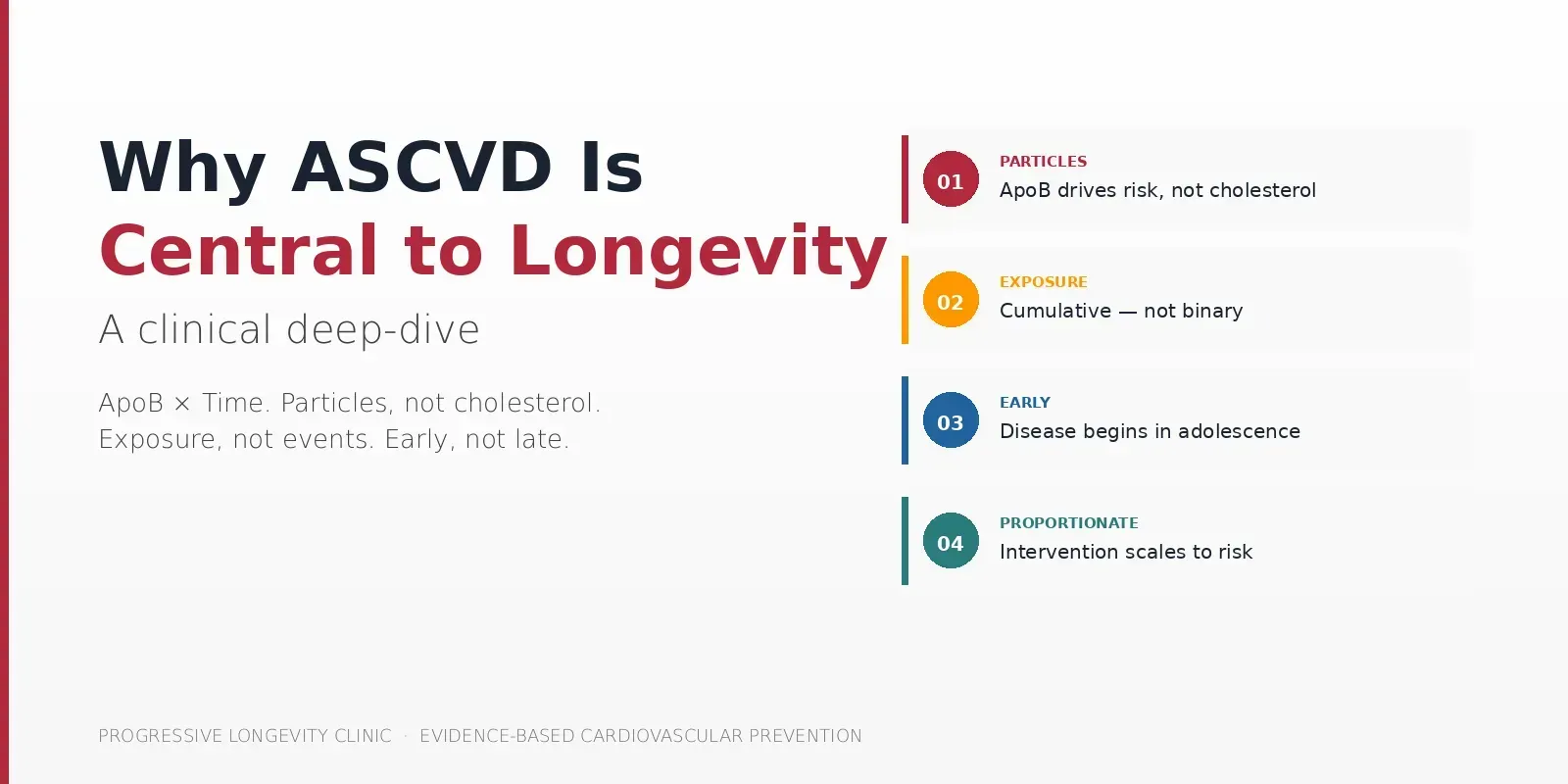
Atherosclerosis is an exposure disease, not an event
Cardiovascular events, when they happen, are late. The biology that leads to them starts early and builds silently, well before any symptom appears. Framing atherosclerosis as cumulative exposure rather than a threshold crossed changes what a clinician or a patient should actually be asking. The relevant question stops being "is my score high enough to act on" and becomes "how much exposure has already accumulated, and for how long."
In a person in their seventies, the 10 year window and the lifetime disease course largely overlap, so a 10 year score reads reasonably well. In a person in their forties, the two windows do not overlap at all. A low score in that group describes the next decade. It says nothing about the two or three decades of exposure that came before it.

What the evidence says about earlier exposure
Ference and colleagues addressed this directly with a Mendelian randomisation analysis published in the Journal of the American College of Cardiology. Comparing people whose genetic variants kept LDL cholesterol lower from birth against people who achieved an equivalent reduction later through treatment, they found the lifelong lower exposure conferred a risk reduction per unit of LDL cholesterol roughly three times greater than the same reduction started in midlife ( Ference and colleagues, 2012). A related analysis in JAMA extended the same logic to combined lifetime exposure to lower LDL cholesterol and lower blood pressure, with the same conclusion: exposure time is not a footnote to the risk equation, it sits inside it ( Ference and colleagues, 2019).
This is not an argument for treating every 40 year old. It is an argument for reading a reassuring score as one input rather than as an answer, particularly where family history or other markers suggest more may be accumulating than the score can see.

What this means in practice
None of this makes the 10 year calculator wrong. It remains useful for what it was built to do: helping decide who meets today's threshold for statin therapy under current guidelines. The change is in how it is used. Read on its own, a low score can read as permission to stop asking questions. Read alongside family history, metabolic markers, and, where appropriate, an advanced lipid panel, it becomes one part of a fuller picture of accumulated risk rather than the whole of it.
Apolipoprotein B, or ApoB, is one of the markers that closes part of this gap, because it counts the atherogenic particles doing the accumulating rather than only the cholesterol they carry. That is a large enough topic to deserve its own detailed treatment elsewhere on this blog. Here it matters only as the next step once cumulative exposure, rather than a single score, is the frame.

Next step
If you are in your forties or fifties with a reassuring risk score and a family history that gives you pause, that combination is worth discussing rather than setting aside. Speak to your GP about a referral, or get in touch with Progressive Sports Medicine to ask about a comprehensive assessment.
A decade of risk can't capture decades of disease. Think long term. Act early.
References
- Ference BA, Yoo W, Alesh I, and colleagues Effect of long term exposure to lower low density lipoprotein cholesterol beginning early in life on the risk of coronary heart disease: a Mendelian randomization analysis. Journal of the American College of Cardiology. 2012;60(25):2631 to 2639. https://doi.org/10.1016/j.jacc.2012.09.017
- Ference BA, Bhatt DL, Catapano AL, and colleagues Association of genetic variants related to combined exposure to lower low density lipoproteins and lower systolic blood pressure with lifetime risk of cardiovascular disease. JAMA. 2019;322(14):1381 to 1391. https://doi.org/10.1001/jama.2019.14120